Pioneering Materials and Systems Co-design for Energy and Industry
How we are different
Planck is built differently, in six ways that matter for the people we work with.
Domain experts who use AI, not AI generalists who picked chemistry. Our founding and technical team are chemical engineers and materials practitioners first. Materials discovery is dominated by failure modes that only domain experts recognise: synthesis side reactions, characterisation artefacts, stability traps, regulatory dead-ends. AI is a tool we apply to a field we know, not the other way around.
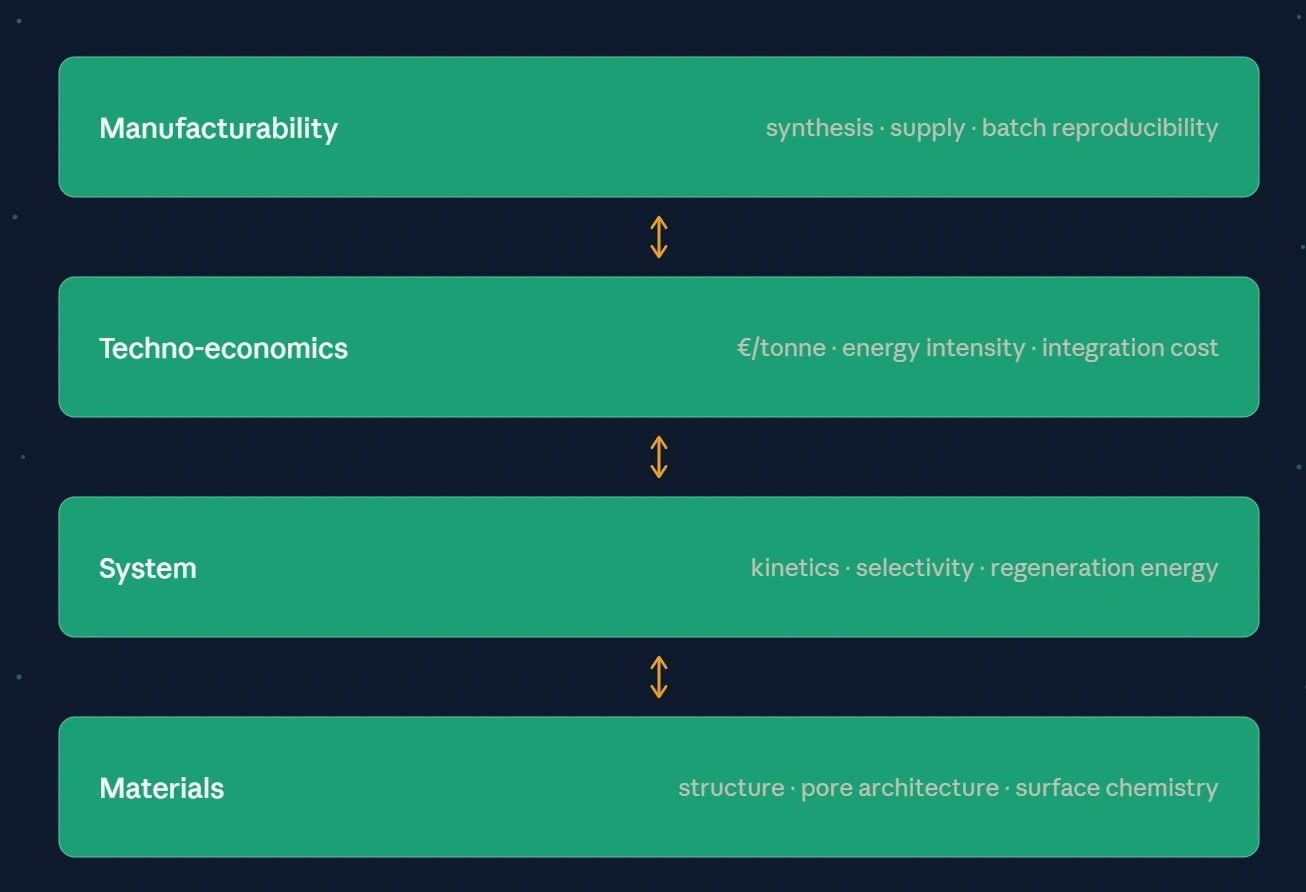
We optimise the full stack, not one layer of it. A predicted property at standard conditions is a number, not a product. Our discovery loop optimises four layers simultaneously, with KPIs from each fed back into the model: materials (structure, composition, pore architecture), system (kinetics, selectivity, regeneration energy under real process conditions), techno-economics (€/tonne CO₂ captured, energy intensity, integration cost), and manufacturability (synthesis at relevant scale, reagent supply, batch reproducibility). A candidate that aces a single property but fails on cost or stability is de-prioritised in the next iteration.
Manufacturability is a discovery constraint, not a downstream problem. We rank every candidate from day one on whether it can be produced at relevant scale, with available reagents, at target cost. This is what separates research papers (which routinely report record numbers) from products that ship.
Physics-informed AI, not benchmark-chasing AI. Our models are constrained by the underlying physics of adsorption, transport, and thermodynamics. Predictions are grounded in physical validity, not in how well a model scores on a leaderboard. When the physics says a candidate cannot work, the model does not propose it.
Asset-light validation through a partner-lab network. Validation work runs through academic and industrial partners, on equipment and expertise that took decades to build. This means we move faster on a leaner footprint, and that experimental results come from labs whose track records are public.
A pipeline of paying clients, not hypothetical demand. Our product portfolio is built through client-paid projects with industrial gas users, biogas operators, CCUS players, and hydrogen producers. Each engagement funds the work, produces a deliverable for the client, and adds proprietary data to the platform. Demand is qualified, not speculative.
The result is a commercial materials platform anchored in real industrial problems, run by people who know the failure modes, and built so that the materials we discover can actually be made, deployed, and paid for.