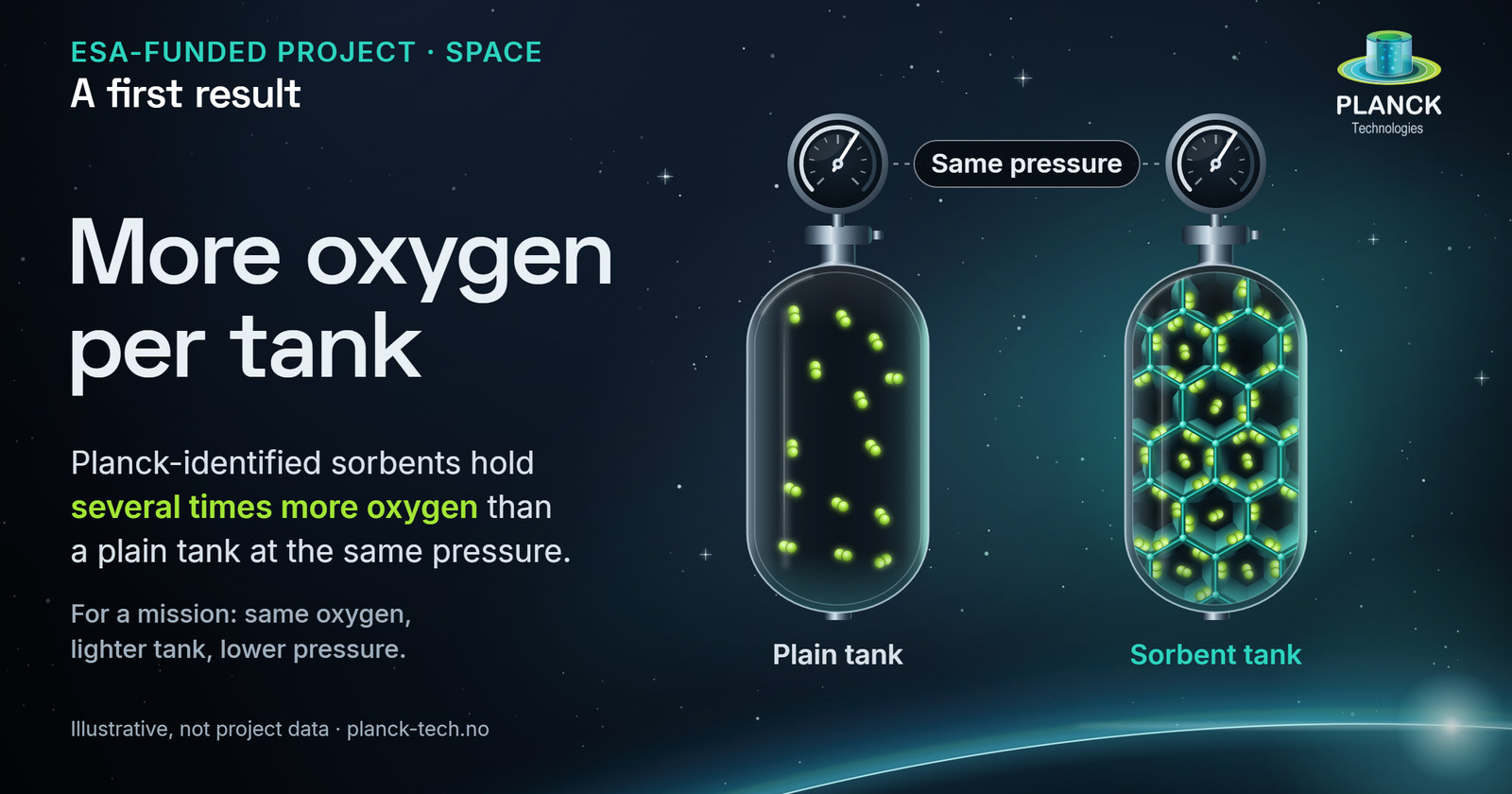
We have a first result from our ESA-funded project on adsorbed oxygen storage for space. Our platform screened tens of thousands of candidate frameworks and identified sorbents that hold several times more oxygen than a plain compressed-gas tank at the same pressure. The predictions were confirmed against measured isotherms.
What it means on a mission
On a mission, that means the same amount of oxygen in a lighter tank at lower pressure. Tank mass and pressure are always a concern in life support, and more so the further a mission travels from Earth. A sorbent tackles the problem from the material side. The porous solid holds oxygen on its internal surface, so the tank isn't relying on pressure alone.
The same workflow, a new gas
For us, the second part of the result is just as important. The co-design workflow we use for CO₂ capture and biogas upgrading also holds for a gas and an environment it was never tuned for, which shows the platform can adapt to non-standard gases and extreme environments.
How we got here
We've shared this work as it progressed. In September 2025, we announced advanced discussions with ESA on adsorbed oxygen storage tailored to space, aiming for safer, more compact and more efficient systems that could make longer, more ambitious missions possible. In December 2025, ESA awarded us a project to advance next-generation oxygen storage for space missions. ESA is now one of our paying customers, alongside a Schlumberger company in CO₂ capture. This first result is the next step.
Back on Earth
The result also backs up something we argued when we were invited to help shape Norway's national space strategy, which is that space and energy should be treated as a single bet. The same materials that help an astronaut breathe can capture CO₂ and store hydrogen here at home.
If mass and pressure set the limits on your gas storage, in space or on the ground, we'd like to hear about it at contact@planck-tech.no.