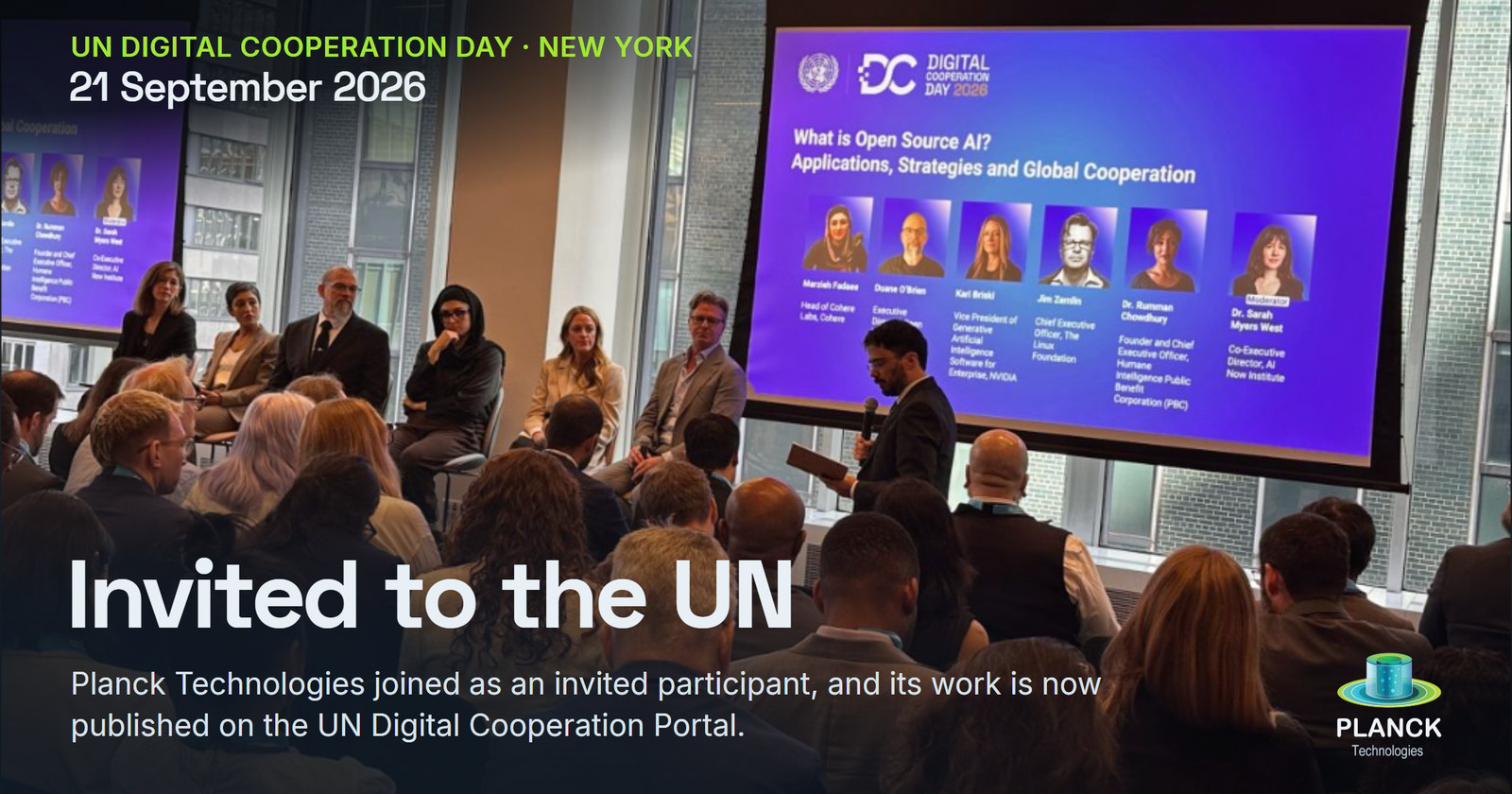
On 21 September 2026 we were in New York for the UN's Digital Cooperation Day. The day was organized by the UN Office for Digital and Emerging Technologies (ODET) during the High-Level Week of the 81st session of the UN General Assembly, and it brought together government representatives, civil society, academia and industry leaders to move digital cooperation forward. We were there as an invited participant, contributing to the day's initiatives, and we brought questions about materials and physical infrastructure into a room where AI policy is shaped.
Our work on the UN Digital Cooperation Portal
ODET also invited us to register our work as a digital initiative on the UN Digital Cooperation Portal. We called it “AI for Materials: Less Energy, Less Carbon, Fewer Critical Minerals and Less Compute”. After a review, it was published on the portal on 22 September 2026, the day after Digital Cooperation Day.
The portal is a UN tool that supports implementation of the Global Digital Compact, adopted at the Summit of the Future in September 2024. It brings together initiatives from across the UN system and other stakeholders, tracks progress at national, regional, global and thematic level, and is open for contributions until the Compact's high-level review in 2027. To be clear, being on the portal isn't a formal UN endorsement or certification. It means an initiative is relevant to digital cooperation and meets basic eligibility and quality criteria.
Why we think materials belong in AI policy
In our view, AI policy is also materials policy. AI models need compute, and the infrastructure that supplies it uses energy, emits carbon and depends on critical minerals. Materials play a part in all three. Cooling data centres is one place where AI and materials meet, and as Shifter reported in September, it's a project we're working on now, designing the material and the system together.
Where the four goals show up in our work
The four goals in our initiative's title are already part of how we work. Fewer critical minerals and less compute are built into the platform. We check element availability and supply-chain risk in the very first stage, before any expensive simulation, and each stage filters out candidates before the next, more expensive one, so total compute drops by orders of magnitude. Less carbon is the point of much of our application work, in CO₂ capture, biogas upgrading and hydrogen storage. And less energy is a design target. In CO₂ capture, we're aiming for sorbents below 1 GJ per tonne, where today's amine plants need 3.5-4 GJ.
Our earlier policy work
This isn't our first time contributing to policy. We've given input to Norway's national strategies for quantum technology and for space, and our Founder & CEO, Dr. Maryam Ghadrdan, contributed to a report by AI & Partners that maps the EU's Cyber Resilience Act against the EU AI Act.
If you work on digital cooperation, AI infrastructure or materials policy, we'd be glad to hear from you at contact@planck-tech.no.